
Commercial epoxy · Huntsville, AL
Commercial Epoxy Flooring
Specced by traffic load and chemical exposure · quoted per job
A commercial epoxy floor gets specced by two questions: what rolls across it, and what spills on it. Answer those honestly and a 100%-solids epoxy system will outwork anything else in a wash-down kitchen, a forklift aisle, or a hangar bay. Answer them wrong and you've bought either a floor that fails early or thickness you didn't need.
How a real spec works
Traffic load and chemical exposure decide everything
Commercial floors are measured in mils. A mil is one thousandth of an inch, and commercial epoxy systems run from about 20 mils for light-traffic broadcast floors to 250 mils for troweled mortar rebuilds. Where your floor lands in that range isn't a taste question — it's set by the heaviest wheel and the harshest chemical the floor will ever meet. The chemistry basics live on our epoxy flooring overview; this page is the commercial spec.
Traffic first. Foot traffic and pallet jacks are easy. Forklifts aren't — a loaded truck puts its whole weight through a few small contact patches, and it turns in place, which shears coatings sideways. Forklift aisles get heavier builds with aggregate broadcast into the resin so the wear happens in sacrificial grit, not the film.
Then chemistry. A machine shop dripping cutting oil, a kitchen running caustic degreaser at closing, a hangar with hydraulic fluid and Skydrol — each of those needs a resin selected against the actual spill list, not "chemical resistant" in a brochure font. We ask for your list before we quote. Every time.
The material itself is 100%-solids epoxy. That phrase means there's no solvent in the bucket — 100%-solids epoxy has no solvent to evaporate, so a 60-mil wet application cures into a 60-mil floor. Solvented products shrink as they dry; what you measure going down is not what you get.
| Service | Typical build | Where it runs |
|---|---|---|
| Foot traffic + carts | 20–30 mils, broadcast | Back-of-house retail, corridors |
| Forklift aisles | 40–60 mils, aggregate broadcast | Warehouses, distribution, shops |
| Wash-down + chemical | 60+ mils with cove base | Kitchens, processing, kennels |
| Impact + rebuild | Up to 250-mil troweled mortar | Spalled aisles, dock aprons |
| Item | Answer |
|---|---|
| Pricing | Specced and quoted per job |
| Cure to full traffic | 3–7 days (epoxy) |
| Faster option | Polyaspartic topcoat, 24–48 hrs |
| Striping | In-system, under the wear layer |
Get a commercial floor specced
Square footage, what rolls on it, what spills on it. With those three we can talk real numbers.
The details that outlive the install
Cove bases and line striping, done inside the system
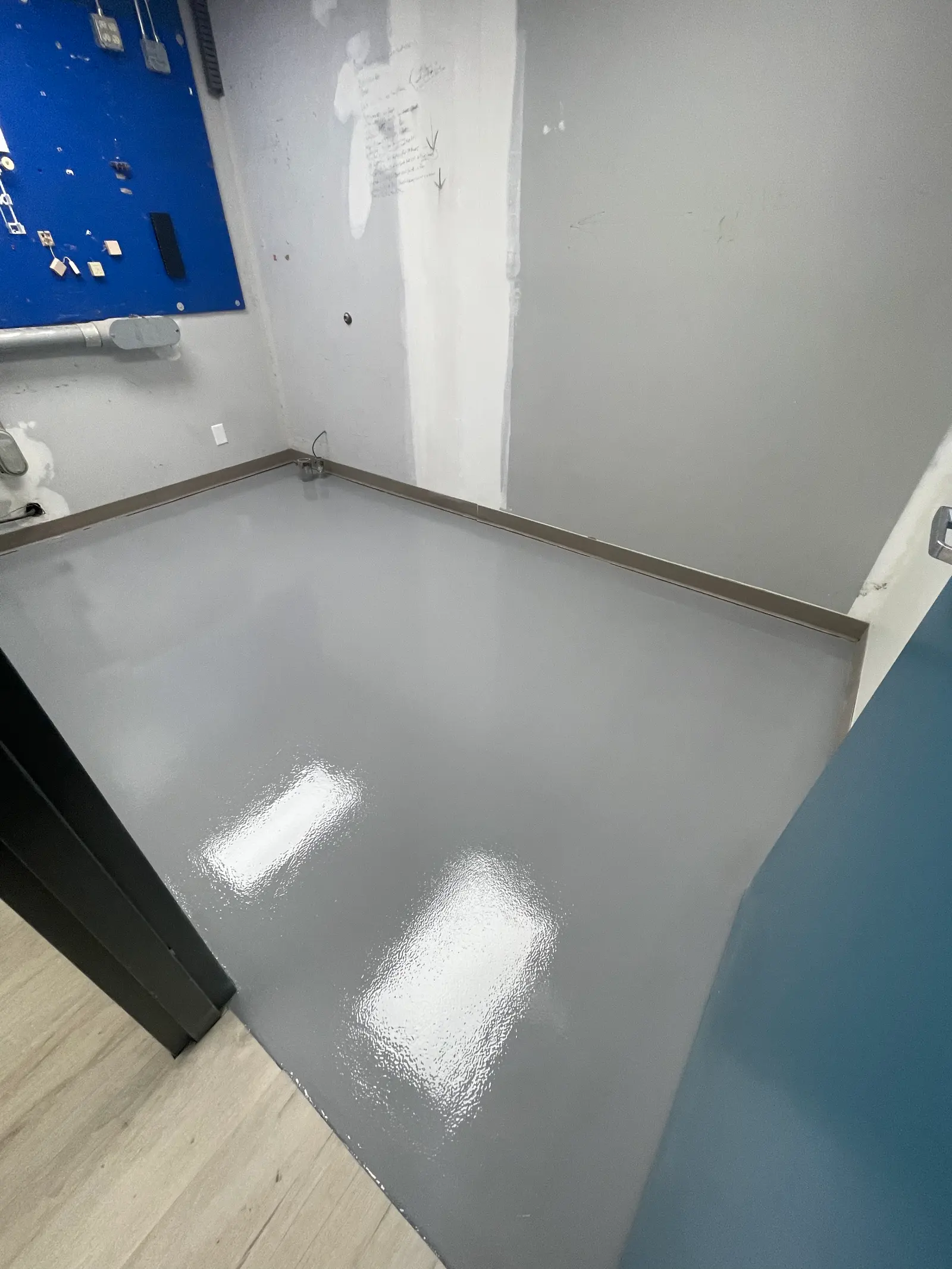
A cove base is the radius of coating material that turns the corner where floor meets wall. A cove base carries the coating 4 to 6 inches up the wall, so wash-down water never finds the joint between slab and wall. In a kitchen or processing room, that joint is where water sits, bacteria grows, and health inspectors look first — which is why wash-down floors without coves keep failing inspections that the floor itself would've passed.
Line striping works the same way: it belongs inside the build. Aisle lines and pedestrian lanes go down as pigmented coats between lifts, then the clear wear layer locks them in. Striping painted on top of a finished floor is gone wherever the forklifts turn, usually within the year.
None of this shows up in a per-square-foot teaser price, which is exactly why we don't quote from one.
Timing matters too. Epoxy needs 3 to 7 days of cure before full traffic; a polyaspartic topcoat over the same build cuts that to 24 to 48 hours. When a Decatur production floor can only give us a holiday weekend, that topcoat swap is usually what makes the schedule work. North Alabama humidity is part of the spec as well — epoxy cures slower and can blush in damp August air, so we plan pours around the dew point instead of hoping.
The honest part
Who shouldn't buy commercial epoxy
If your floor is a big open slab — bulk warehouse, distribution bays, flex space waiting on a tenant — and nothing corrosive ever hits it, you probably shouldn't be on this page. Polished concrete usually wins there: no film to wear through, no recoat cycle ever, and on large footage it tends to cost less per foot than a coating built thick enough to survive the same forklifts. That work lives on our commercial concrete polishing page.
Epoxy earns its keep where the floor needs a membrane — chemical exposure, wash-down sanitation, containment, or color and striping requirements polish can't deliver. If you're not sure which side of that line your building sits on, the polished concrete vs epoxy comparison was written for exactly this decision, by the one local company installing both.
We make the same margin either way. The diagnosis is free, and it's honest because it can afford to be.
Spec it right
Commercial Polishing
The no-coating alternative for big open floors — forklift-rated, nothing to recoat, cheaper at scale.
Compare the approach →Polished vs Epoxy
The decision page: membrane or no membrane, written by installers of both systems.
Read the comparison →Epoxy Flooring Basics
What epoxy is, where it wins, and why we keep it out of residential garages.
Start with basics →Questions we actually get
What does commercial epoxy flooring cost in Huntsville?
How thick should a commercial epoxy floor be?
Can you install commercial epoxy without shutting us down?
Do you do line striping and safety markings?
Get a number, not a runaround
Tell us what you're working with and we'll give you a straight price range on the phone. No pressure visit required to hear a number.