
Floor problems · Huntsville, AL
Concrete Moisture Problems
vapor transmission, in plain language
Concrete is porous, and a slab poured without a plastic vapor barrier underneath — standard practice before the 1980s — moves ground moisture up to its surface year-round. That movement is called vapor transmission, and it's the quiet force behind most of the blistered, peeling, and sweating floors in this valley. Here's how to recognize it, how it actually gets measured, and the three honest ways to build a floor on top of it.
The mechanism
What vapor transmission is
Think of a slab as a very slow sponge standing on damp ground. Water in the soil evaporates into the concrete's pores, drifts upward as vapor, and exits at the surface — invisibly when the floor is bare, destructively when something airtight is sitting on top.
Modern construction puts a plastic vapor barrier under the pour to slow this down. Older construction often didn't, which is why the pre-80s slabs in Five Points, Athens, and along the river in Decatur are the wettest concrete we test. Add this valley's water table and a humid nine-month growing season, and vapor transmission isn't an edge case here. It's the default assumption our flagship system was specced around.
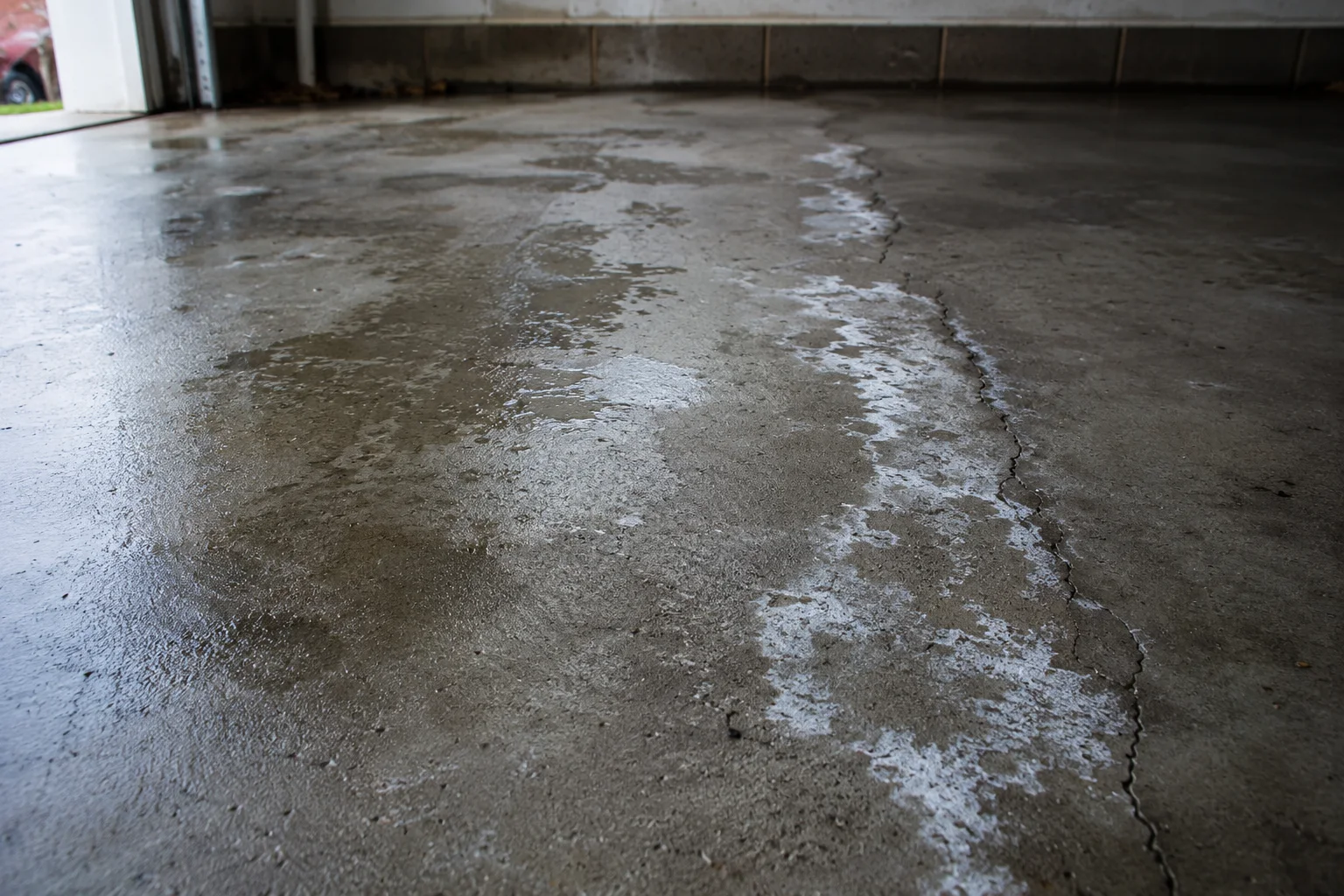
The symptoms cluster into four patterns — the table covers what each one is telling you. One definition worth knowing because you'll see the word everywhere: Efflorescence is the white mineral residue left when moisture evaporates at the concrete surface: the water leaves, the dissolved minerals stay.
If you've already got a blistered or peeling coated floor, that's its own diagnosis path — start at why coatings peel.
| Symptom | What you see | What it means |
|---|---|---|
| Sweating slab | Damp or wet surface with no spill in sight | Vapor from below or condensation from above — the tape test tells them apart |
| Efflorescence | White, chalky mineral residue on the surface | Moisture is moving through the slab and evaporating at the top |
| Dark patches | Shadowy areas that never quite dry out | An active vapor path, often over poor drainage or a plumbing line |
| Blistered coating | Bubbles or domes in an existing floor | Vapor pressure beat a moisture-sensitive coating |
Suspect a wet slab?
Describe the symptom on the phone and we'll tell you whether it's worth testing before anyone sells you a floor.
Measurement, not vibes
How a slab actually gets tested
You can screen a slab yourself this weekend. A taped-down square of plastic left on the slab for 24 hours is the cheapest moisture screen there is — condensation on the underside means the slab is pushing vapor. It won't give you a number, but it separates "the air is humid" from "the ground is pushing water through my floor" — which is the question that matters most.
When a coating decision rides on it, we measure. Calcium chloride testing measures how many pounds of vapor a 1,000 sq ft slab pushes out in 24 hours; we test before coating instead of guessing. In-slab relative humidity probes go a step further and read the moisture condition inside the concrete rather than at its skin.
What we won't do is recite impressive-sounding cutoff numbers at you on a webpage. The honest answer is that acceptable readings depend on which base coat is going down — the thresholds come off the product's datasheet, and they go on your quote where you can hold us to them.
One sentence to keep: a contractor who quotes a coated floor without mentioning moisture testing has already made your slab's most important decision by not making it.
| Test | What it measures | Why it matters |
|---|---|---|
| Plastic sheet (tape) test | Plastic square taped down for 24 hours | Free screen — condensation underneath means vapor is moving |
| Calcium chloride test | Vapor emitted per 1,000 sq ft per 24 hours | The quantitative standard for coating decisions |
| In-slab RH probe | Relative humidity inside the slab itself | Reads the core of the concrete, not just the surface |
| Thresholds we coat to | {{TODO:verify-spec}} | Set by the base coat datasheet, printed on the quote |
Three ways out
Building a floor over a slab that moves moisture
Tolerate it. Polyurea base coats handle vapor levels that blister rigid, moisture-sensitive epoxy — the cured film deals with pressure from below instead of fighting it to a loss. For most Huntsville slabs, the right base coat is the whole answer.
Mitigate it. When readings come back genuinely high, a mitigation primer goes down first — a dense coating applied to ground concrete specifically to choke vapor before the decorative system is built on top. It's the largest single add on a coating quote, and on a wet slab it's not optional. We'll show you the readings that triggered it.
Sidestep it. Some slabs shouldn't get a film at all — and we say that as a company that sells films. Polished concrete has no coating for vapor to push against; the slab simply breathes through its own finished surface. For very wet older slabs, it's often the best floor and the best money, and it's all laid out at concrete polishing.
Which door you take is the slab's decision, not ours. That's what the testing is for.
Keep researching
The Moisture-Tolerant System
Why our base coat is polyurea, layer by layer, with the products named.
See the system →Polishing — the Sidestep
The no-film floor for slabs that would fight a coating forever.
See the alternative →Peeling Coatings
What moisture failure looks like after the fact — the tear-out evidence.
Read the autopsy →Questions we actually get
My garage floor sweats in August. Is that a moisture problem in the slab?
Can I just paint on a moisture-blocking sealer from the hardware store?
Will a dehumidifier fix my damp concrete floor?
Does a wet-testing slab mean I can't have a coated floor?
Get a number, not a runaround
Tell us what you're working with and we'll give you a straight price range on the phone. No pressure visit required to hear a number.