
Floor problems · Huntsville, AL
Why Garage Floor Coatings Peel
diagnosis first · then the fix path
Garage floor coatings peel for three reasons: moisture vapor pushing up under a moisture-sensitive base coat, concrete that was never properly prepped, and hot tire pickup on builds too thin to handle a parked car's heat. That's the whole answer — everything else on this page is evidence. We tear out failed floors around Huntsville regularly, and what we find underneath is so consistent it reads like a checklist. Here's the autopsy, then the fix.
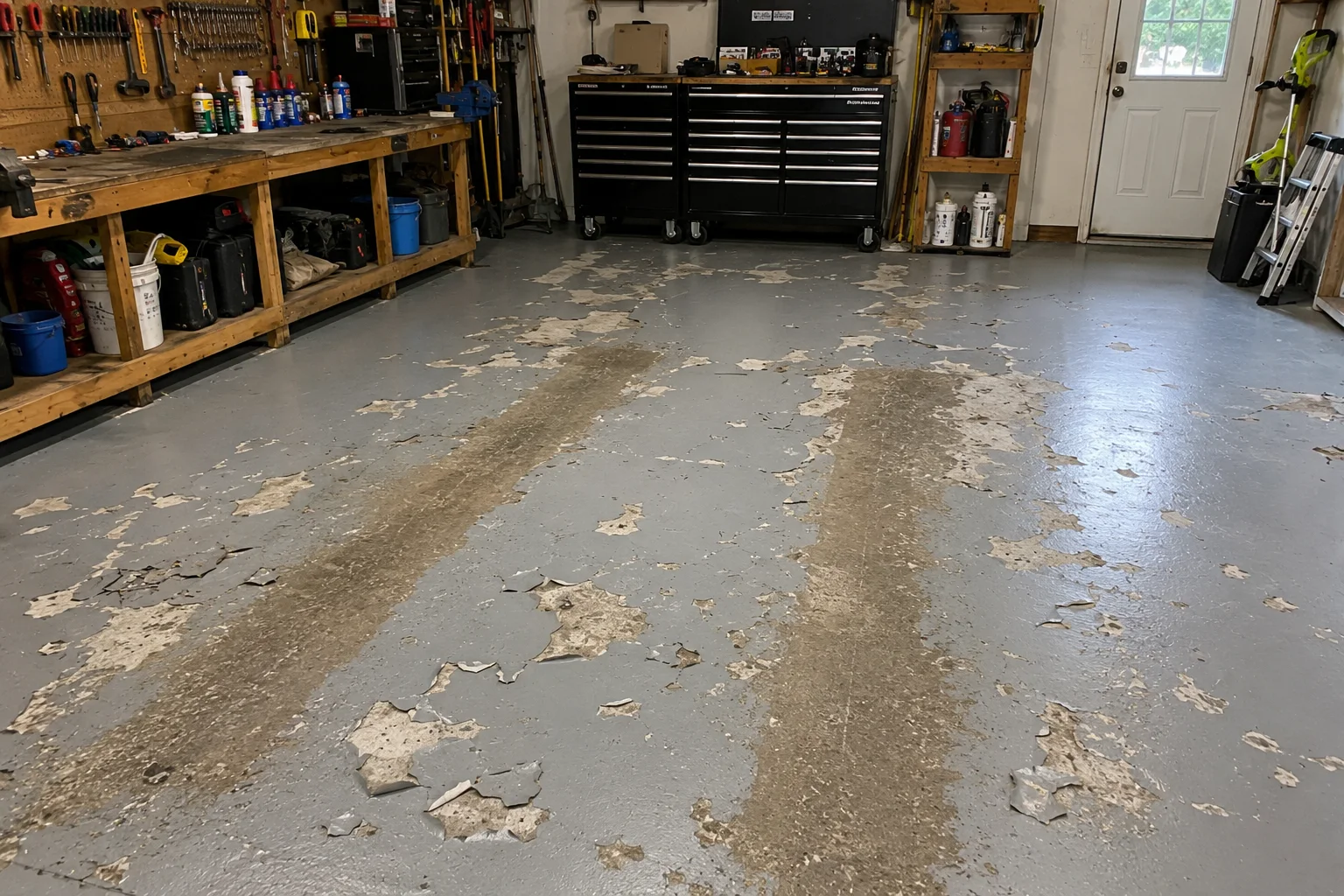
The autopsy
What we find under failed floors
When we grind off a peeling floor before installing the Rocket City System, the story is usually written on the back of the old coating.
The acid-etched DIY kit. The most common tear-out. A $200 kit can't include a diamond grinder, so the instructions say acid etch — which leaves the weak surface cream in place for the coating to bond to. Surface cream is the weak, fine-cement skin on top of every slab — etching roughens it but doesn't remove it, so the coating peels off holding a thin gray layer of your floor like tape pulling paint.
The paint-grade "epoxy." One-part epoxy paint sold as a floor coating. It's a few mils thick — a real system is many times that — and it has no answer for a parked car. Hot tire pickup leaves two clean, tire-width strips where the car parks — the coating releases as the tires cool and contract overnight.
The single roller coat. Sometimes a previous contractor's work, not a homeowner's. One coat, no flake, no topcoat. It wears through at the door line, water gets under the edge, and the peeling spreads from there like a sticker losing its corner.
And under all three, often, the real culprit: a slab that was never moisture-tested. Pre-1980s slabs around Huntsville were often poured without a vapor barrier, and they show up in our tear-outs far more often than newer concrete.
| What we find | What went wrong | How it fails |
|---|---|---|
| Acid-etched DIY kit | Coating bonded to surface cream, not concrete | Lifts in sheets, often within 1–2 summers |
| Paint-grade “epoxy” | One-part epoxy paint, a few mils thick | Hot tires pull it up in tire-width strips |
| Single roller coat | No flake layer, no topcoat, no build | Wears through at the door line first |
| Coating over a wet slab | Blisters with liquid or powder underneath | Vapor pressure beat a moisture-sensitive base coat |
Got a peeling floor?
Send a photo of the worst spot when you call. We can usually name the failure before we visit.
The fix path
How a failed floor gets fixed for good
Three steps, in an order that doesn't change.
1. Grind it all off. Diamond grinding takes the failed coating and the weak surface cream down to sound, open concrete. Every square foot, including the parts still hanging on — partially stuck old coating is the worst thing you can build on.
2. Test the slab. Before anything new goes down, we measure what the concrete is doing. If the original floor died of moisture, recoating without testing just schedules the sequel. What the readings mean and how vapor moves through a slab is covered on the concrete moisture problems page.
3. Rebuild on polyurea. The new base coat is the decision that breaks the cycle. Polyurea tolerates the slab vapor that kills moisture-sensitive epoxy bases, and it goes on at a thickness hot tires can't peel. Full flake broadcast and a polyaspartic topcoat finish the build.
If your failed floor was a DIY kit, don't feel bad — the kit was designed to be installable in a weekend, not to survive a Huntsville August. The honest comparison of what the kit can and can't do is at DIY epoxy kit vs professional.
Keep researching
The System That Replaces It
Polyurea base, full flake, polyaspartic topcoat — every layer specced in writing.
See the system →Moisture Problems
The slab condition behind most coating failures here, and how we test for it.
Understand the cause →DIY Kit vs Professional
Why the weekend kit peels, and the one situation where it still makes sense.
Compare honestly →Questions we actually get
Can you recoat just the section that's peeling?
How do I know if my peeling floor was a moisture failure or a prep failure?
Will a new coating just peel again?
Does the old coating have to come off completely?
Get a number, not a runaround
Tell us what you're working with and we'll give you a straight price range on the phone. No pressure visit required to hear a number.