
Guide · Huntsville, AL
Polished Concrete Maintenance
Dust mop · neutral-pH cleaner · never wax
Polished concrete is the lowest-maintenance floor we install, but low-maintenance isn't no-rules. The whole discipline fits on an index card: dust mop the grit, wet clean with a neutral-pH cleaner, never wax, and wipe acid spills the minute they happen. This page is the index card with the reasons attached.
The routine
Day to day: a mop and a pH number
Day-to-day care for polished concrete is a dust mop; wet cleaning is a neutral-pH cleaner — pH 7, neither acidic nor alkaline — because anything stronger chemically etches the polish. The pH rule sounds fussy until you know what a polished floor actually is: ground stone hardened with a densifier, with no protective film over it. Acidic cleaners dissolve the polished surface directly — that's etching. Strong alkaline cleaners go after the densified surface and leave it hazy. Neutral cleans without picking either fight.
Never wax a polished floor: wax is a sacrificial film that dulls the gloss you paid for, then has to be stripped with exactly the aggressive chemicals polish hates.
Wax sounds like protection. On polish it's vandalism with extra steps.
The commercial schedule
Re-burnishing: gloss on a cadence
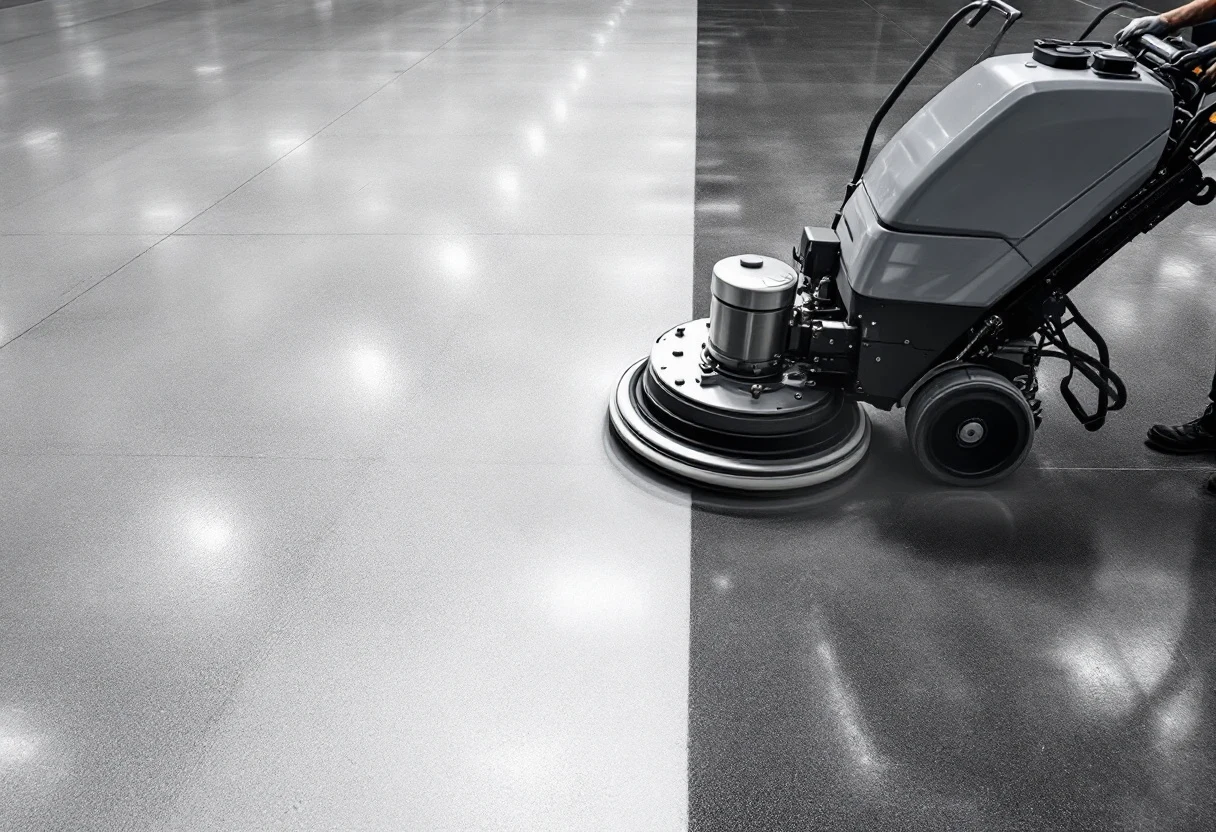
Commercial polished floors run on a re-burnish cadence — roughly every 6–12 months for high-traffic retail, every 1–2 years for warehouse aisles. A burnisher is a high-speed buffing machine — no grinding, no dust containment, usually done overnight without closing anything. It's how a grocery aisle keeps its sheen under thousands of cart passes a week, and it's a line item, not a project.
Homes mostly skip this. Residential foot traffic is gentle enough that a polished den or converted garage may go many years before anyone thinks about gloss.
| Task | Cadence | Why |
|---|---|---|
| Dust mop | Daily–weekly by traffic | Grit is the enemy; this removes it before shoes grind it in |
| Wet mop, neutral-pH cleaner | Weekly or as needed | pH 7 only — acids etch, alkalines dull |
| Lift + clean under mats | Weekly in commercial entries | Trapped grit sands the polish from below |
| Acid spills | Wipe immediately | Etching is chemical damage; no cleaner reverses it |
| Re-burnish (commercial) | 6–12 months retail · 1–2 years warehouse | Restores gloss without grinding |
| Lane re-polish | As lanes dull, in years | Local fix at a fraction of any recoat |
| Wax or topical sealer | Never | Dulls the gloss, then demands harsh strippers |
The threat list
What actually kills polish
Three things, in the order we see them. Dragged pallets and steel feet — sliding hard loads scores the surface in a way no cleaner caused and no burnish fixes. Put wheels or sliders under it. Acid spills left to sit — etching is permanent chemistry, and speed is the only defense. Grit trapped under mats — the sneaky one, sanding the floor from below while the mat looks like it's helping.
And one honest admission: traffic lanes dull anyway. Traffic lanes dull over years no matter what you do, and re-polishing just the lane costs a fraction of recoating anything. Years of wheels and footsteps win eventually, in the lanes, while the rest of the floor still looks new. The fix is local and cheap — which, compared against how coatings fail, is half the argument in the polished concrete vs epoxy comparison. For floors taking real abuse daily, the heavier-duty schedule lives with our commercial polishing work.
Go deeper
Concrete Polishing
How a slab becomes a polished floor — diamond grinding, grits, and densifier.
See the service →Commercial Polishing
Burnish cadences, overnight scheduling, and big-footage floors built for carts and carts of traffic.
See the service →Polished Concrete vs Epoxy
How each floor fails and what fixing it costs — the maintenance argument, extended.
Read the comparison →Questions we actually get
What cleaner should I use on polished concrete?
What do I do if something acidic spills on the floor?
Does polished concrete need to be resealed?
Why is grit under mats such a problem?
Get a number, not a runaround
Tell us what you're working with and we'll give you a straight price range on the phone. No pressure visit required to hear a number.