
Comparison · Huntsville, AL
Flake vs Solid Color
One hides everything, one shows everything
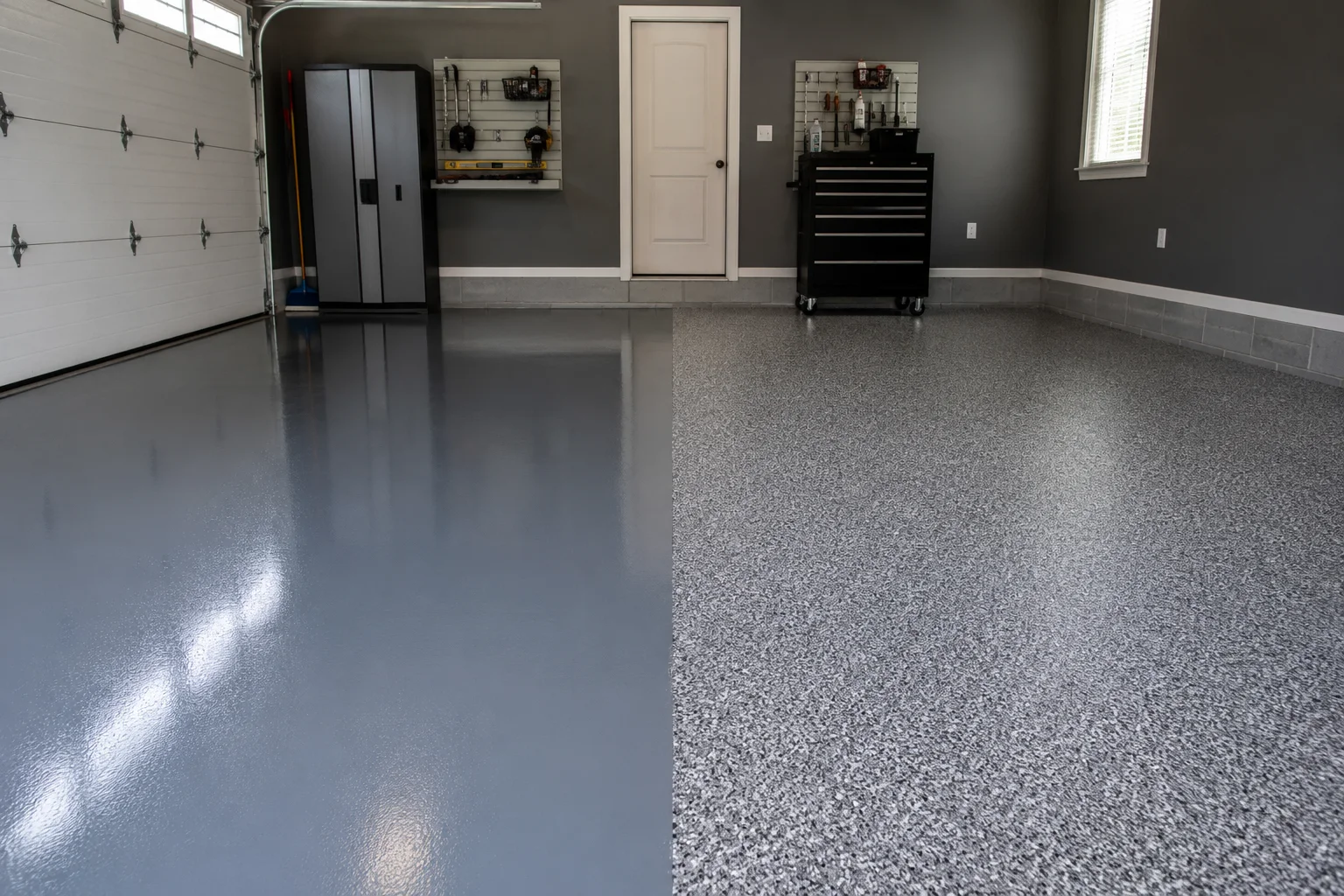
Flake hides — red clay track-in, dust, the crack repair under bay two. Solid color shows all of it, but reads clean and modern in a way flake never will. Price won't settle this one; the two finishes cost about the same. What settles it is how often you're honestly going to clean the floor.
The case for flake
Camouflage you can park on
Most flake floors here get the 1/4-inch cut in a blend of 3 or more colors, and that visual noise is exactly what hides red clay track-in, dust, and old slab repairs. It's the same reason granite countertops forgive crumbs: a busy pattern gives debris nowhere to register. On a garage floor that actually works for a living, that camouflage is most of what you're buying.
A full broadcast adds real mil build on top of the resin alone, plus a light texture underfoot that a solid-color floor needs a grit additive to match. The flake goes into the wet base coat in a full broadcast — thrown until the floor won't accept more — so it's structure, not sprinkles. There are a couple dozen blends to argue about at the kitchen table; the flake color gallery renders them all.
If you stop reading here and just pick a mid-gray blend, you'll be fine. Most people should.
The case for solid color
Who should buy the floor that shows everything
A solid-color floor hides nothing — plan on wiping it down weekly instead of squeegeeing twice a year if you want it to keep reading clean.
Said plainly, solid color is a commitment, and some buyers should make it anyway. Showrooms and detail shops, where the floor is part of the presentation and gets cleaned daily regardless. Commercial brand floors, where the company color underfoot is the point. And the weekly-squeegee minimalists — you know if this is you — who'd find flake visually noisy and genuinely enjoy a floor with nothing on it.
What solid color is not: a shortcut to cheaper. Flake and solid-color coatings land in the same $5–$9 per square foot range; prep drives the quote, not the flake. If anyone quotes you a dramatically cheaper solid floor, the savings came out of the prep or the mils, not the flake bag.
| Full-broadcast flake | Solid color | |
|---|---|---|
| Hides dirt + dust | Yes — that's the job | No; every leaf and drip shows |
| Hides slab repairs | Crack fills disappear into the pattern | Repairs telegraph through |
| Texture / slip | Built-in light texture | Smooth; wants a grit additive |
| Mil build | Full broadcast adds thickness | Resin layers only |
| Look | Granite-like, busy up close | Clean, modern, showroom |
| Cleaning honesty | Squeegee twice a year | Weekly wipe-downs to stay sharp |
| Cost | $5–$9/sq ft | $5–$9/sq ft — same range |
| Verdict | Working garages, kids and dogs, red clay country — almost everyone | Showrooms, commercial brand floors, and weekly-squeegee minimalists who want the clean look |
Stuck between two blends — or between blend and no blend?
Tell us what parks on the floor and how often you sweep. We'll tell you which finish you'll still be glad about in year five.
One warning
Don't judge either finish from a box photo
The "flake" in a DIY kit is paint chips sprinkled over thin epoxy — a different material at a different coverage, and it ages like it. If a neighbor's flake floor looks sparse and sad, you're probably looking at a kit, not a broadcast. The difference is itemized on our DIY kit vs professional page.
A real full broadcast reads as one continuous surface from standing height. That's the standard to judge against.
Go deeper
Flake Color Gallery
Two dozen blends rendered from their actual color formulas — pick favorites before we visit.
Browse blends →DIY Kit vs Professional
Paint chips vs vinyl flake is one line in a longer, more expensive story.
Read the comparison →Garage Floor Coating
The full service both finishes ride on: prep, base coat, broadcast, topcoat.
See the service →Questions we actually get
Does flake cost more than solid color?
Is a flake floor less slippery than solid color?
Which flake blends hide North Alabama red clay best?
Can I do solid color in the bays and flake everywhere else?
Get a number, not a runaround
Tell us what you're working with and we'll give you a straight price range on the phone. No pressure visit required to hear a number.