
Guide · Huntsville, AL
What Are Torginol Flakes?
Vinyl flake · 1/8", 1/4", and 1" cuts · blended colors
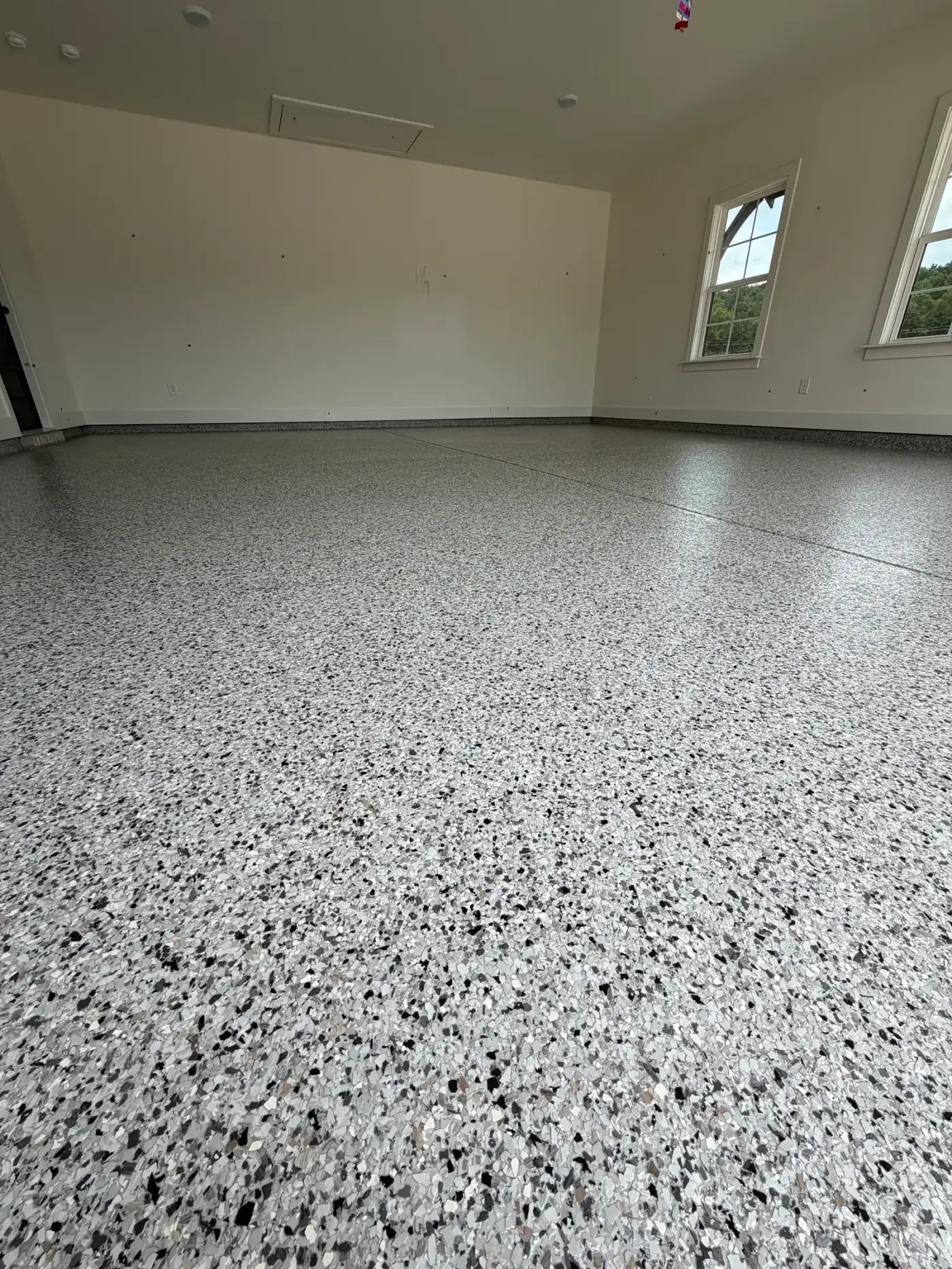
Torginol is the vinyl flake manufacturer most professional installers use, and the flakes themselves are random-shaped vinyl chips in blended colors, thrown by hand into a wet base coat. They're the middle layer of a coated floor — the part you actually see — and they're doing more structural work than the color-swatch conversation suggests.
The entity, plainly
One company makes most of the flake you've walked on
Torginol is the vinyl flake manufacturer most professional installers use; the flakes are random-shaped vinyl chips in blended colors, broadcast by hand into the wet base coat. If you've stood on a flake floor in a dealership, a fire station, or a neighbor's garage, odds are it was Torginol material under a clear topcoat. It's the layer we broadcast in every system floor we install, and naming it on the quote is the point — "decorative chips" tells you nothing checkable.
The random shapes aren't sloppiness; they're the design. Irregular edges keep the pattern from tiling visually, which is what lets a floor full of individual chips read as one continuous surface.
Sizes and blends
How the look gets tuned
Torginol flake comes in 1/8-inch, 1/4-inch, and 1-inch sizes; 1/4-inch is the standard cut most garage floors get. Size sets the pattern's scale; the blend sets its color logic.
A typical blend mixes 3 to 5 colors so the floor reads as one tone from standing height while hiding dust and small repairs up close. That's the trick of a good blend — contrast does the hiding, while the average of the colors does the decorating. It's why a five-color gray blend hides a dusty footprint that a single-color gray floor would put on display. Browse the actual mixes in the flake color gallery.
| Size | Look | Where it fits |
|---|---|---|
| 1/8 inch | Fine, dense, quieter pattern | Modern interiors, smaller rooms, finer texture underfoot |
| 1/4 inch | The standard — balanced scale | Most garages; hides debris and repairs at normal viewing height |
| 1 inch | Bold, terrazzo-like | Big floors, showrooms, statement spaces with the area to carry it |
The spec that separates installers
Full broadcast vs partial
Full broadcast means flake goes down until the wet base coat physically can't accept more; partial broadcasts save material up front and wear into visible bald patches later.
Full broadcast — the trade calls the end state "rejection," because the floor literally rejects further flake — isn't a style choice. The flake layer adds mil build, hides slab imperfections, and gives the topcoat texture to key into. A partial broadcast does a fraction of each, and the savings show up as thin spots right where the tires live.
Whether you want flake at all is its own question, with a fair fight on the other side: flake vs solid color.
But if the answer is flake, the only spec worth accepting is full.
Go deeper
Flake Color Gallery
The blends rendered from their actual color formulas — bring your shortlist to the estimate.
Browse blends →Flake vs Solid Color
The honest comparison, including who should skip flake entirely.
Read the comparison →The Full System
Where the flake layer sits between the polyurea base and the polyaspartic topcoat.
See the system →Questions we actually get
Are vinyl flakes just the "chips" that come in DIY kits?
Do flake colors fade?
Which flake size should I pick?
Can we build a custom blend instead of a stock one?
Get a number, not a runaround
Tell us what you're working with and we'll give you a straight price range on the phone. No pressure visit required to hear a number.