
Guide · Huntsville, AL
What Is Simiron Polyurea?
A manufacturer, a chemistry, and the layer your floor stands on
Two answers, because it's two questions. Simiron is a US coatings manufacturer. Polyurea is a resin chemistry that cures fast, stays slightly flexible after it sets, and tolerates moisture during cure — plain meaning: damp air or vapor rising through the slab won't stop it from bonding. Put together, it's the base coat under every floor we install, and this page explains why.
The chemistry half
Polyurea, defined like a neighbor would
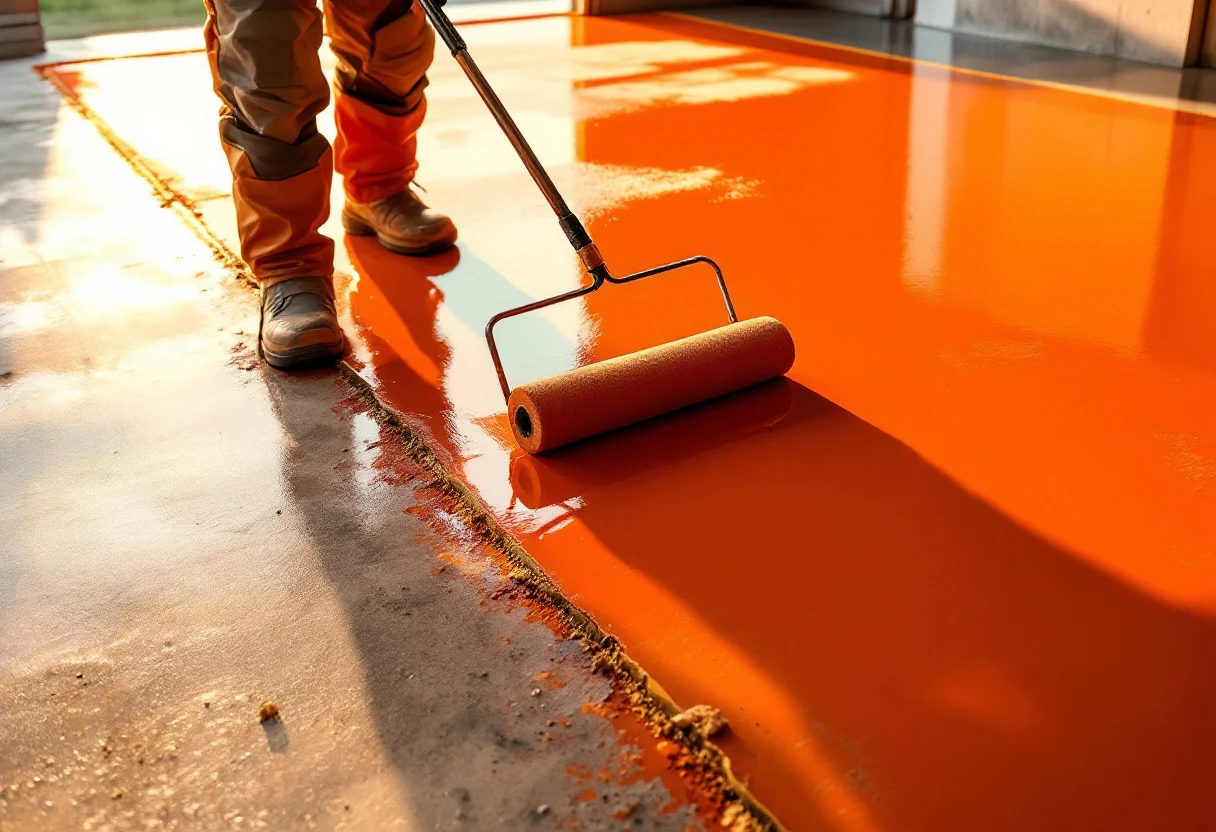
Polyurea is a resin chemistry, not a brand: it cures fast, stays slightly flexible after it sets, and tolerates moisture during cure — meaning vapor in the slab won't stop it from bonding. Those three traits read like a spec sheet until you map them onto a real slab. Fast cure means the crew recoats the same day instead of coming back tomorrow. Slight flex means the film survives a slab that swells and shrinks with the seasons on our clay. Moisture tolerance means a spring install doesn't gamble on what the concrete's doing underneath.
Epoxy — the resin it replaced as the base coat of choice — loses on all three, and that head-to-head has its own page: polyurea vs epoxy.
Simiron's polyurea base goes down at 10–12 mils {{TODO:verify-spec}} and is ready to recoat in about 1–2 hours, which is the spec that makes a one-day install possible.
The manufacturer half
Who Simiron is, and why one manufacturer
Simiron is a US coatings manufacturer, and its polyurea is the base coat on every residential floor we install. It's the named base coat of the system we install — on the quote, not behind a vague line like "commercial-grade resin."
We standardized on one manufacturer on purpose: the crew knows exactly how this product behaves in August humidity and in a 45-degree January garage. Resins are temperamental; the same bucket behaves differently at 95 degrees and thick humidity than it does in a cold garage in January, and the only way a crew learns those moods is repetition with one product. Installers who swap brands every quarter to chase price are re-learning that curve on someone's floor. We'd rather it not be yours.
To be straight about it: other good manufacturers exist. Standardizing isn't a claim that Simiron is the only answer — it's a claim that knowing your materials cold beats sampling the catalog.
| Spec | Value | Why it matters |
|---|---|---|
| Role in the system | Base coat — the bonding layer | Everything above it rides on this bond |
| Applied thickness | 10–12 mils {{TODO:verify-spec}} | Build without brittleness |
| Recoat window | ~1–2 hours | Enables base-to-topcoat in one day |
| Working time | Minutes — crew product {{TODO:verify-spec}} | Why there's no DIY version |
| Moisture during cure | Tolerated — bonds through slab vapor {{TODO:verify-spec}} | The North Alabama requirement |
| Cured behavior | Slightly flexible | Moves with the slab instead of shearing |
Where it sits in the stack
One layer of three
The polyurea never sees daylight. Above it goes a full broadcast of vinyl flake — covered in what are Torginol flakes — and a UV-stable polyaspartic topcoat that takes the scratches, sun, and tires. The base coat just does the one thing nothing else in the stack can do: hold the whole assembly onto concrete that's alive underneath it.
It's the least photogenic layer on the floor and the only one a warranty genuinely depends on.
Go deeper
The Full System
All three layers — polyurea base, flake broadcast, polyaspartic topcoat — specced in order.
See the system →Polyurea vs Epoxy
The base-coat head-to-head: moisture, flexibility, recoat windows, and the DIY question.
Read the comparison →What Are Torginol Flakes?
The layer that goes into the polyurea while it's still wet.
Read the guide →Questions we actually get
Is Simiron the only good coating manufacturer?
Is floor polyurea the same stuff as spray-on truck bed liner?
Why does moisture tolerance during cure matter so much here?
Could Simiron polyurea be used as the topcoat too?
Get a number, not a runaround
Tell us what you're working with and we'll give you a straight price range on the phone. No pressure visit required to hear a number.