
Floor problems · Huntsville, AL
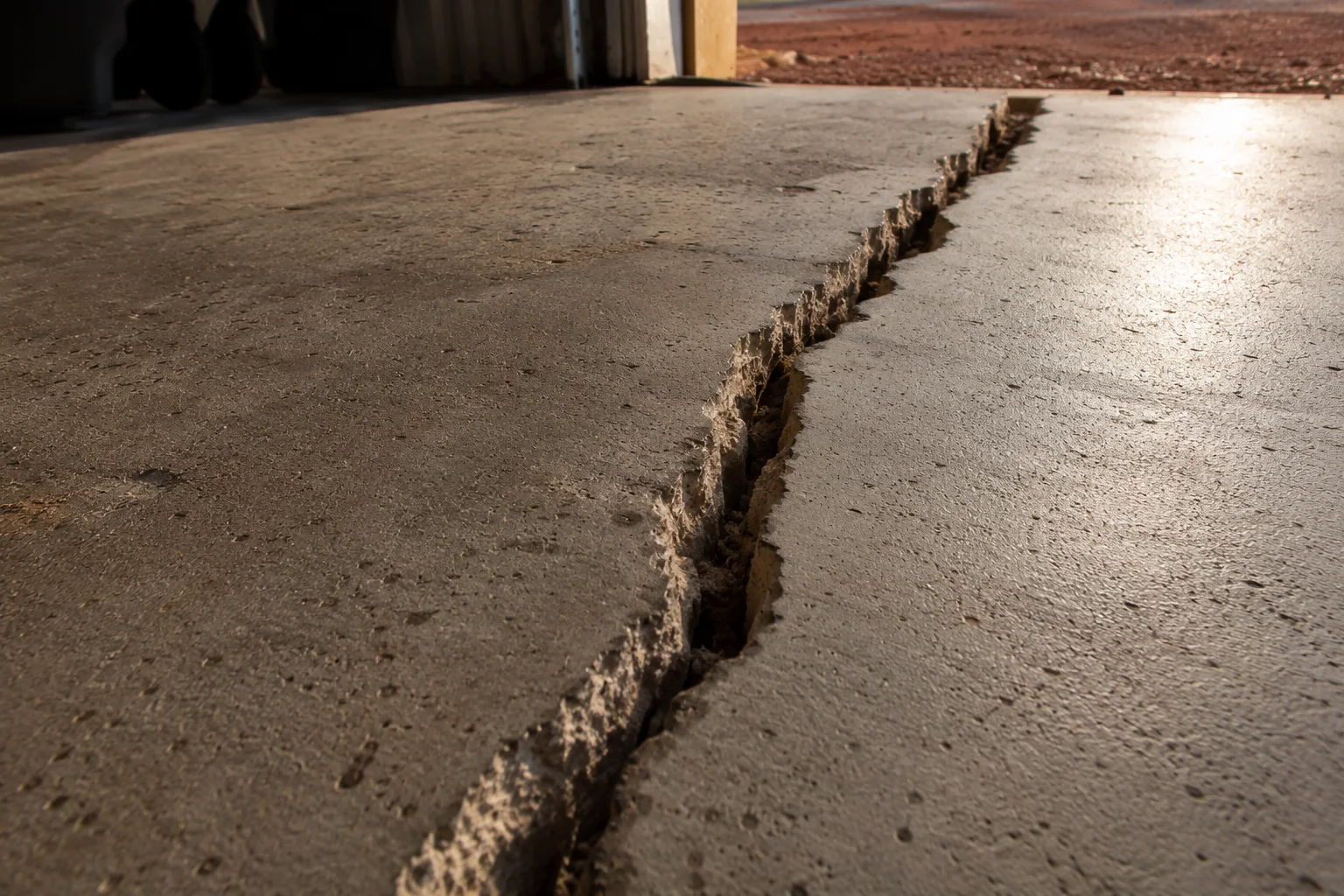
Cracked Garage Floor
three crack types · two are fixable with a floor
Most garage floor cracks are shrinkage cracks that opened in the slab's first year, and they're cosmetic — routed out, polymer-filled, and coated over, they disappear into the floor. The question that matters isn't whether your slab is cracked — nearly every slab in the valley is — it's which of the three crack types you're looking at. Two of them are a flooring problem. One of them isn't, and we'll tell you which before we take your money.
Plain definitions
The three kinds of cracks
Before any crack goes under a garage floor coating, it gets sorted into one of three bins.
Shrinkage cracks happen because concrete shrinks as it dries, and the slab cracks where it relieves the tension. They're thin, they wander, and they stopped being news the year your house was built. Routine repair: we rout the crack into a clean channel, fill it with flexible polymer, grind it flush, and coat.
Settlement cracks mean the ground under the slab moved and the concrete followed it down. These can be done moving or still in progress — and that's the whole question. Settled-and-finished gets repaired and coated. Still-sinking gets a harder conversation.
Working cracks are cracks that still open and close — seasonally, or every time something heavy rolls over them. Coat over a working crack and the new floor cracks along the same line, usually within a year. No filler changes that physics, and nobody honest will coat one.
Of the three crack types — shrinkage, settlement, and working — only the first two can be coated, and settlement only after the movement has demonstrably stopped.
| Type | Plain definition | Coat over it? |
|---|---|---|
| Shrinkage crack | The slab cracked while relieving tension as it dried, usually in its first year. | Yes — rout, polymer-fill, coat |
| Settlement crack | The ground under the slab moved, and the slab followed it down. | Usually — once the movement has stopped |
| Working crack | A crack that still opens and closes with the seasons or under load. | No — the coating cracks along the same line |
Not sure which crack you've got?
Text us a photo with a tape measure in frame. Crack triage over the phone is free.
Why here
Why North Alabama slabs crack
Two local forces do most of the cracking around here, and neither one cares how good your concrete finisher was.
Expansive clay. The red clay under much of the newer construction north and east of the city holds water like a sponge and gives it back in drought — swelling and shrinking under the slab with the weather. Newer neighborhoods in Harvest and Hampton Cove see it most: slabs five years old with cracks their owners assume mean something terrible. Usually they don't. The clay moved; the slab answered.
Karst. Much of Madison County sits on karst — limestone bedrock that dissolves slowly and lets soil migrate into voids — so some local slabs settle decades after the pour. That's the slower, quieter cause — and it's why a 1970s slab in southeast Huntsville can crack in 2026 having behaved itself for fifty years.
Neither cause is a reason to panic. Both are reasons to have someone classify the crack before coating it.
The honest boundary
What a coating can't fix
A floor coating is a wear surface, not a structural repair. It doesn't stop settlement, doesn't stabilize soil, and doesn't hold a moving slab together.
If your crack shows vertical offset that's growing, or it lines up with sticking doors and stair-step cracks in the brick outside, you need a foundation contractor before you need us. We'll say exactly that at the measure — a coating over an unresolved structural problem is our least favorite kind of repeat customer.
And when the crack is the routine kind, the repair is built into the published cost range — crack work moves a quote within the range, not outside it.
Keep researching
The Garage Coating Service
What goes over the repaired slab — system, schedule, and when coating is the wrong call.
See the service →Harvest, AL Floors
Coating slabs on expansive clay — why flexible repairs matter most where the houses are newest.
Harvest specifics →Peeling Coatings
The other big failure mode — what we find under floors that let go.
Read the autopsy →Questions we actually get
Will the repaired cracks show through the flake?
One side of my crack sits higher than the other. Can you fix that?
Should I fill the crack myself before you come out?
Does a cracked garage slab mean my foundation is failing?
Get a number, not a runaround
Tell us what you're working with and we'll give you a straight price range on the phone. No pressure visit required to hear a number.